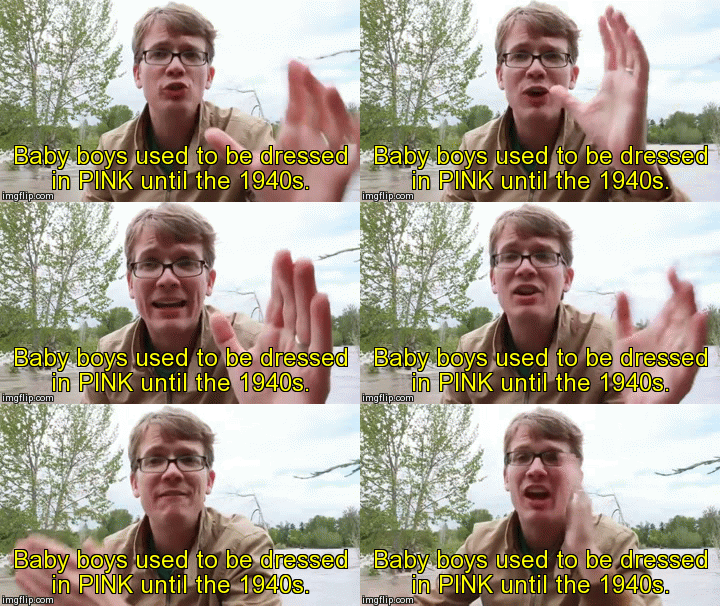
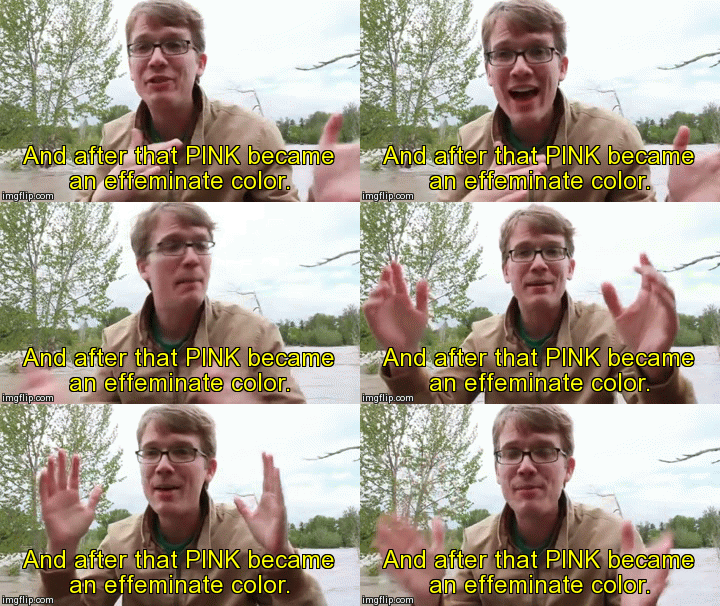
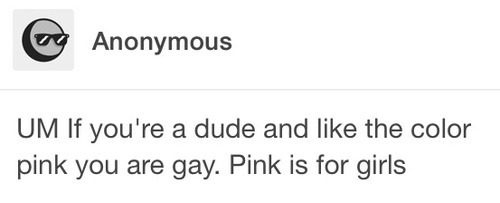
“Ew you’re a guy and like the color pink are you gay?”
I’ve been waiting for this post all my life
Pink is player
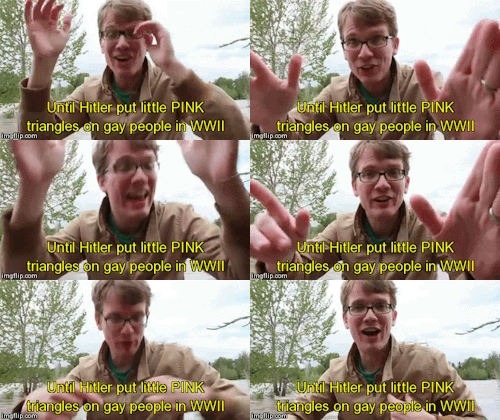
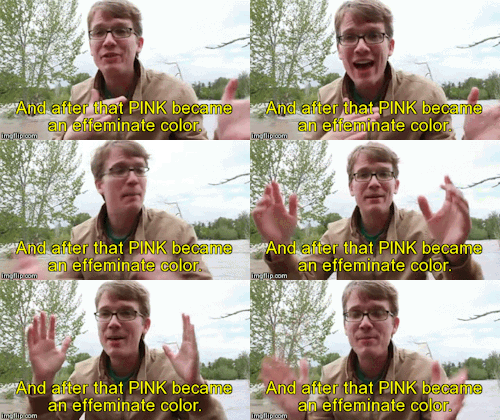
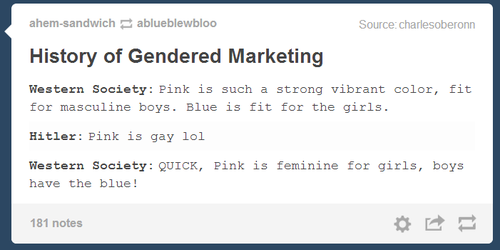
HEY GUYS WANT TO KNOW WHEN AND WHY IT WAS ACTUALLY FEMINIZED COMPLETE SOME ACTUAL SOURCES?! LET’S HISTORY FOR A MINUTE:
For most of Western history pink did not have the gender connotations it does today. So what happened?
Pink actually used to be a masculine color, blue a feminine one
Before the 20th Century, young men and women alike wore pink clothing.
Pink actually leant more on the masculine side
– it was seen as a lighter shade of red which was thought to be a ‘fierce’ and ‘warlike’ color and therefore was more appropriate for boys.
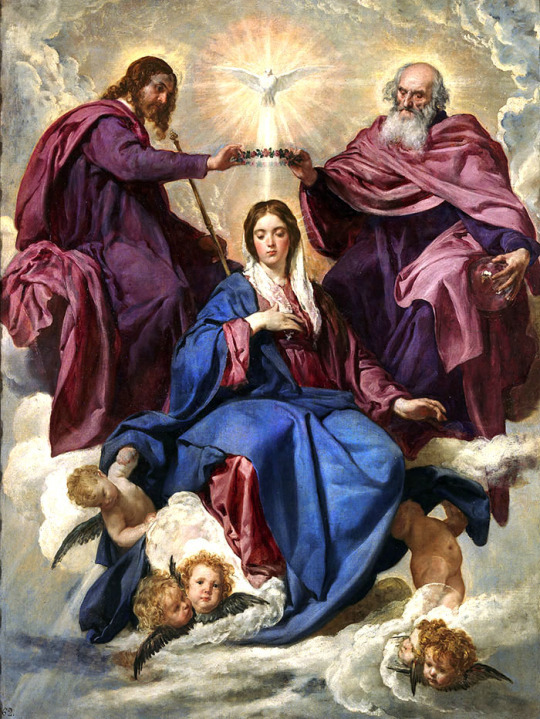
Blue was more associated with girls since the Virgin Mary is customarily dressed in blue robes
in paintings and sculptures. In the 15th Century painting above, both God the Father and Jesus are painted wearing pink while Mary wears blue robes.
The early 20th century continued this trend with newspapers like the The Sunday Sentinel in 1914 offering tips to new parents such as “If you like the color note on the little one’s garments, use pink for the boy and blue for the girl, if you are a follower of convention”.
In 1927, Time magazine printed a chart showing sex-appropriate colors for girls and boys according to leading U.S. stores. In Boston, Filene’s told parents to dress boys in pink. So did Best & Co. in New York City, Halle’s in Cleveland and Marshall Field in Chicago.
-The beginnings of a shift
Today’s color dictate began in the 1940s as a result of Americans’ preferences as interpreted by manufacturers and retailers.
Stores found that people were increasingly choosing to buy pink for girls, and blue for boys and slowly began to market them as such, but this was far from a universal convention.
That would happen in the coming decades.
-How a first lady changed pink forever
Okay, so let’s set the scene. During WWII 11 million men and women served in the US military, all needing uniforms. This strained the country’s supply of fabric, the price of civilian clothing skyrocketed and restrictions were brought in.
Clothing using less fabric became fashionable and people conserved materials in this grim time.
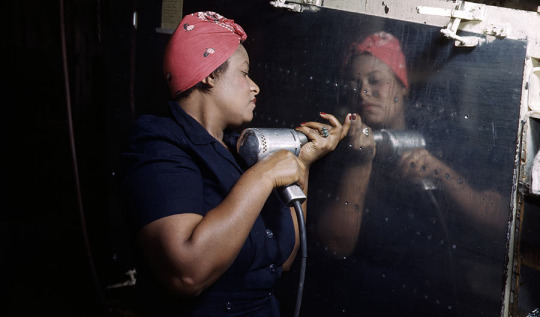
The 2.2 million women working in factories supplying soldiers with munitions and equipment would have been used to wearing simple blue denim outfits like this riveter in 1943.
This practicality would go on for years, even after the war, while the country was still recovering.
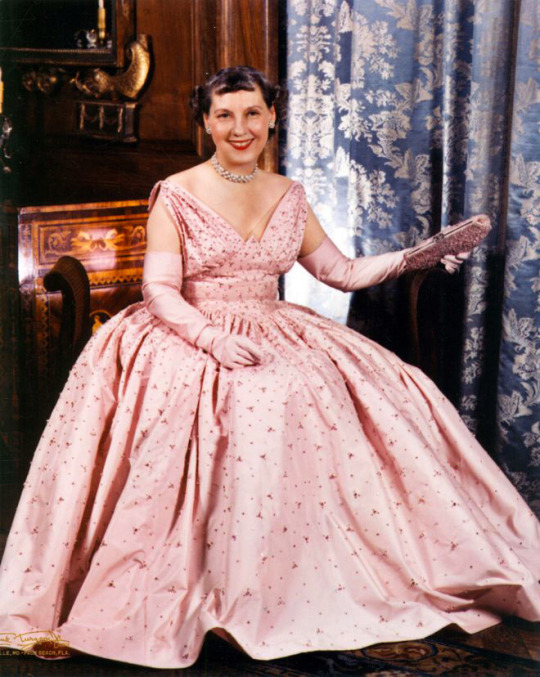
Then, in 1953, the general who ‘won the war’ Dwight Eisenhower, was elected as president. At his inauguration, his wife, Mamie Eisenhower, turned up in a shockingly ostentatious, enormous, full length, bright pink gown, embroidered with more than 2,000 rhinestones.
It may look fairly basic now but this was a ‘break the internet’ type of moment (before there was an internet) and a complete departure from the wartime styles of the previous decade.
Mamie would wear pink – her favorite color – everywhere, it was her signature. It was a completely arbitrary, personal preference – she thought it went well with her complexion – but this was a major turning point in the story of pink.
It became widely accepted as a feminine color and women everywhere began wearing it to emulate the glamorous first lady.
This was solidified and exemplified in the 1957 smash hit film ‘Funny Face’ starring Audrey Hepburn. Think of it as the ‘Devil Wears Prada’ of it’s time.
Watch the fashion magazine editor declare that today’s modern woman needs to “Think Pink!”
This trend coincided with the post WWII economic expansion, sometimes referred to as ‘The Golden Age of Capitalism’, the period from the end of the war to the mid 1970′s.
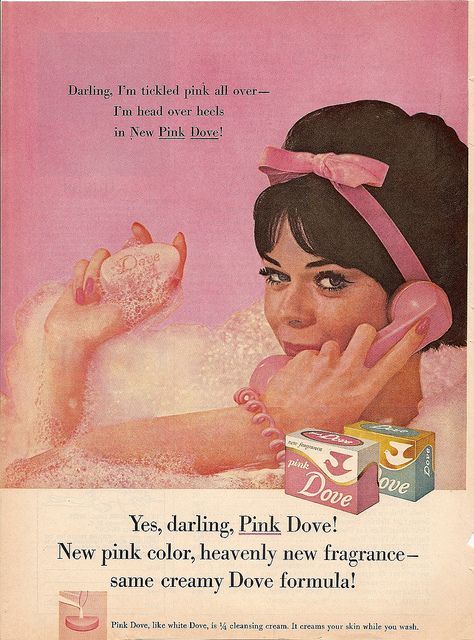
Companies looking to rebrand their products to capitalize on this emerging market used pink to energize and modernize products, this 1960 advert for ‘new’ pink soap being an example.
From here on in, pink was everywhere, from clothes to interiors, cars and furniture, it was universally accepted as a symbol for femininity.
This trend became a cultural norm throughout the Western world and beyond and remains the case to this day.
So no, it wasn’t Hitler, but Mamie Eisenhower, who was the first person to initiate Halloween decorations be put up in the white house, clipped coupons, acted as a gracious host and had recipe for “Mamie’s million dollar fudge” is the reason pink is associated with girls and femininity.






 Rockets in the sky